
Summary:
You’ve got a project on your hands — demo day is coming, debris is going to pile up fast, and now you’re trying to figure out whether to rent a dumpster or just pay someone to take it all away. It’s a reasonable question, and the answer isn’t always obvious. The wrong call can mean paying for a second container you didn’t plan for, or standing around waiting for a crew when you could’ve loaded the thing yourself in an afternoon. This page walks you through both options honestly, covers what Nassau County homeowners and contractors actually run into, and helps you figure out which approach makes sense for your specific situation.
Construction Dumpster Rental vs. Full-Service Debris Removal
These two services solve the same problem — getting rid of construction debris — but they work very differently, and the cost comparison isn’t as simple as it looks on paper.
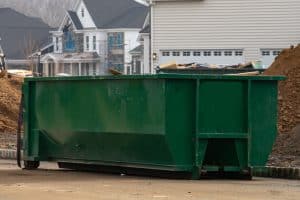
With a dumpster rental, a roll-off container gets dropped at your property. You load it on your schedule, and when you’re done, it gets picked up. You’re doing the physical work, but you’re in control of the timeline. With full-service removal, a crew shows up, handles all the loading, and hauls everything away — usually in a single visit. You don’t touch a thing.
The right choice depends on three things: how much debris you’re dealing with, how much time you have, and whether you’re physically able — or willing — to do the loading yourself.
When Renting a Dumpster Makes More Sense for Construction Projects
For most mid-to-large construction projects in Nassau County, a dumpster rental is the more cost-effective option — as long as you size it correctly and understand what you’re getting into.
If you’re doing a full kitchen gut in a 1950s cape cod in Levittown, you’re looking at lath-and-plaster walls, old tile, cast-iron pipes, and original cabinetry. That debris accumulates over days, not hours. A dumpster lets you work at your own pace, tossing material as you go without waiting for a crew or coordinating pickups around your schedule. For contractors running a job site, this kind of flexibility is often worth more than the cost savings alone.
The same logic applies to roofing tear-offs, bathroom renovations, deck demolitions, and basement finishing projects. Anything where the debris builds gradually over the course of a project is a natural fit for a rental. You load it when it’s convenient, and it gets picked up when you call.
Where people run into trouble is underestimating how heavy construction debris actually is. Drywall, tile, concrete, and roofing shingles are dense. A dumpster that looks more than big enough by volume can exceed its weight limit before it’s even close to full — and weight-based overage charges typically run $75 to $100 per ton over the limit. That’s not a small number, especially if you’re a few tons over. Sizing up usually costs less than $100 more upfront. A second dumpster costs the full rental price again.
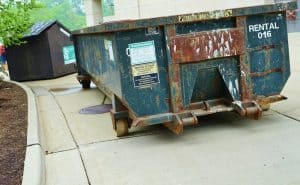
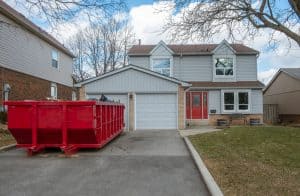
The other thing worth knowing: if you’re placing a dumpster on the street rather than your driveway, you’ll likely need a permit from your local municipality. Nassau County has three towns, two cities, and 64 villages — and they don’t all follow the same process. A 20-yard roll-off container is about 18 feet long and fits in most Nassau County driveways. A 30-yard container is a different story, and whether it can go on the street depends on which community you’re in.
When Full-Service Junk Removal Is the Smarter Call
Full-service removal gets overlooked by people who assume it’s always more expensive. Sometimes it is. But for smaller jobs, or for situations where time and physical effort are real factors, it can actually be the more practical choice.
If you’re clearing out a single room, removing leftover construction materials after a contractor finishes, or dealing with heavy, awkward items that are genuinely difficult to load safely — a crew that shows up and handles everything can be worth every dollar. You’re not just paying for disposal. You’re paying for the labor, the truck, and the time you’d otherwise spend doing it yourself.
It’s also worth thinking about the physical reality of loading a construction dumpster. Hauling broken concrete, heavy tile, or demolished cabinetry into a roll-off container isn’t light work. For homeowners who aren’t doing the demo themselves, loading a dumpster after a contractor has already left the site can mean a full day of heavy lifting — or more. If that’s not something you’re set up for, full-service removal makes the comparison a lot closer than the price difference suggests.
There’s also a scenario that comes up more than people expect: the project scope changes mid-job. You rented a dumpster for a bathroom renovation, and now you’re also clearing out the basement. Or the contractor found more behind the walls than anyone anticipated. In those cases, having access to full-service removal as a backup option — rather than scrambling to find a separate company — keeps the project moving without a detour.
This is actually where we’re different from most providers in Nassau County. We offer both services under one roof, which means you can start with a dumpster rental and call for a full-service pickup if the job grows. You don’t have to choose one or the other upfront and hope the project cooperates.
Large Dumpster Rental Sizes for Nassau County Construction Projects
Picking the right dumpster size is one of the most practical decisions you’ll make before a construction project starts — and it’s also one of the most commonly misjudged.
The instinct is usually to go with what looks big enough based on the visual pile of debris. But construction materials don’t behave like household junk. They’re dense, irregularly shaped, and deceptively heavy. Getting the sizing right from the start is the difference between a smooth project and an expensive mid-job scramble.
Here’s a straightforward look at how the sizes break down for construction work specifically.
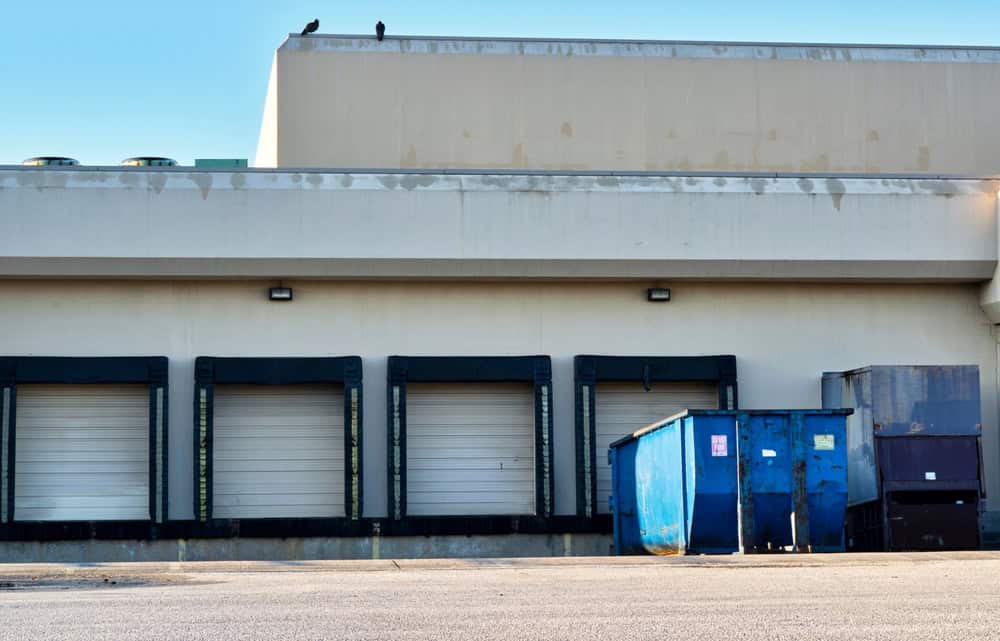
Which Dumpster Size Is Right for Your Construction Project?
A 10-yard dumpster is the right call for smaller, contained jobs — a roof tear-off on a ranch home, a single bathroom demo, a fence teardown, or a garage cleanout. It fits easily in most Nassau County driveways and handles the debris from a focused, single-trade project without taking up more space than you need.
A 20-yard dumpster is the most common choice for mid-size residential renovations — kitchen guts, bathroom remodels, flooring replacement across multiple rooms, or a full interior cleanout. At about 18 feet long, it fits in the majority of Nassau County driveways, which matters in communities where lot sizes are tight and staging space is limited. This size handles volume well, but if your project involves a lot of tile, concrete, or plaster, weight becomes a real consideration.
A 30-yard container is what most contractors reach for on larger jobs — full home remodels, multi-room demolitions, deck and addition teardowns, or anything where debris is going to accumulate over multiple days and multiple trades. It holds roughly the equivalent of nine pickup truck loads of material. That’s the standard for a serious construction project, and it’s sized to keep the job moving without mid-project pickups.
For large-scale demolition, new construction, or commercial projects, a 40-yard container is the appropriate choice. It requires a double-car driveway or a dedicated job site staging area — not practical for every Nassau County property — but when the project calls for it, it’s the right tool.
One thing that catches people off guard: the weight limits on these containers are set with general debris in mind. Construction debris, especially concrete, brick, and roofing materials, can push a container past its weight limit well before it’s visually full. If your project involves heavy materials, it’s worth discussing that specifically when you call — not after the container is picked up and weighed.
Most people don’t think much about what happens after the dumpster gets picked up. But it’s worth understanding, especially if you’re dealing with older materials, mixed debris, or anything that might require special handling.
Standard construction and demolition debris — wood, drywall, metal, concrete, roofing materials — goes through a sorting and processing stage before any of it reaches a landfill. Recyclable materials like metal and clean concrete are separated out. Wood framing and dimensional lumber often gets diverted as well. The goal is to minimize what actually ends up in the ground, and we take that responsibility seriously.
What can’t go in a standard construction dumpster is equally important to know before you start loading. Hazardous materials — paint, solvents, refrigerants from old HVAC units, and certain adhesives — require separate disposal. If you’re working in a Nassau County home built before 1978, there’s a real possibility of encountering asbestos in floor tiles, pipe insulation, or ceiling materials. That’s not a dumpster situation. That requires a certified abatement contractor before any demo work begins.
For everything else, the process is straightforward. You load the container, we pick it up, and the material gets processed and disposed of properly. We’re fully licensed and insured, which means the disposal chain is documented and legal — not a concern you have to carry. For contractors who need to demonstrate compliance on permitted projects, that matters.
Nassau County’s south shore communities — Long Beach, Oceanside, Freeport, Merrick — have seen a second wave of renovation projects in recent years, partly driven by homeowners updating properties that were rebuilt or repaired after Hurricane Sandy. That kind of work often involves mixed debris from multiple trades, which is exactly where having a single, reliable waste removal partner makes the logistics significantly simpler.
We sort recyclables, minimize landfill load where we can, and handle disposal the right way. That’s not a marketing line — it’s how we operate, and it’s part of what being a licensed hauler on Long Island actually requires.
Choosing the Right Construction Waste Removal Option in Nassau County, NY
Here’s the short version: rent a dumpster when your project is large, debris builds over time, and you want control over the loading. Go full-service when the job is smaller, the materials are heavy, or your time is worth more than the price difference. And if the project is somewhere in between — or likely to change — having access to both options from the same company removes a lot of the guesswork.
Nassau County’s housing stock is old, the lots are tight, and the municipalities don’t all follow the same rules. That combination means the generic advice you’ll find on a national website doesn’t always translate cleanly to a kitchen gut in Hicksville or a full demo in Massapequa. Local knowledge matters.
If you’re still not sure which direction makes sense for your project, a quick call is the fastest way to figure it out. We serve Nassau County and all of Long Island — same-day delivery available, no hidden fees, and no time limits on rentals. Reach out and we’ll help you make the right call before the project starts, not after.